Almost every joint in furniture is a compromise between three things: how much load it will carry, how it behaves when the wood around it swells and shrinks, and how long it takes to cut. Most joints settle one of those well and the other two badly. The mortise and tenon settles all three, which is why it has outlived nearly every attempt to replace it.
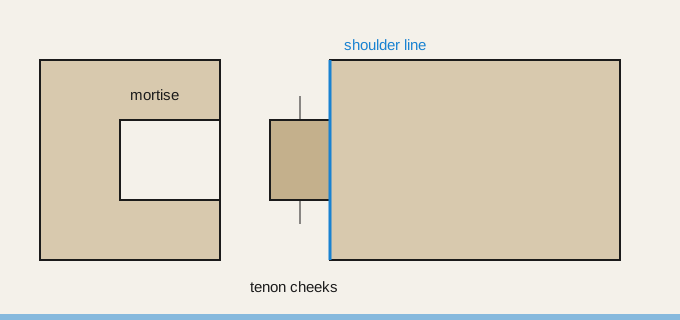
The strength comes from geometry rather than from adhesive. A tenon is a tongue cut on the end of one piece; a mortise is the matching rectangular hole cut into the face of another. When the tenon goes home, the shoulders around it bear against the face of the mortised piece, and that shoulder contact is what stops the joint racking. A chair that wobbles is almost never a chair whose glue failed. It is a chair whose shoulders never touched properly in the first place.
The glue surface matters too, but not in the way people expect. The two cheeks of the tenon are long grain meeting long grain, and that is the only glue joint in woodworking that is reliably stronger than the wood itself. The ends of the tenon meet end grain, which glues poorly and can be ignored. So the cheeks do the holding and the shoulders do the bracing, and a joint cut with that division of labour in mind is a good deal easier to cut well.
Sharpening treated as an occasional project produces tools that are dull most of the time, because the threshold for starting a project is high and the threshold for carrying on with a slightly dull blade is low. Treated as maintenance, a blade goes back to the stones for a minute at a time, several times a session, and it is never actually blunt. The equipment hardly matters next to the frequency. Whatever is at hand, kept out on the bench rather than put away, will produce sharper tools than a better arrangement kept in a cupboard.
Stock moved from an unheated outbuilding into a heated room needs weeks to settle, not days, and it needs air on every face while it does. Stickered in a stack with spacers between the layers, boards give up moisture evenly and stay flat. Piled solid on the floor they dry from the outside in, and the outer boards cup while the inner ones stay wet. Anything cut from the stack before it has stopped moving will be cut to a dimension that no longer exists a month later.
A surface left by a sharpened edge and a surface left by an abrasive are not the same surface at a finer or coarser degree. They are different in kind, and no progression of grits converts one into the other.
A panel glued from several boards can be flatter and more stable than any single wide board, provided the boards are arranged rather than simply joined.